
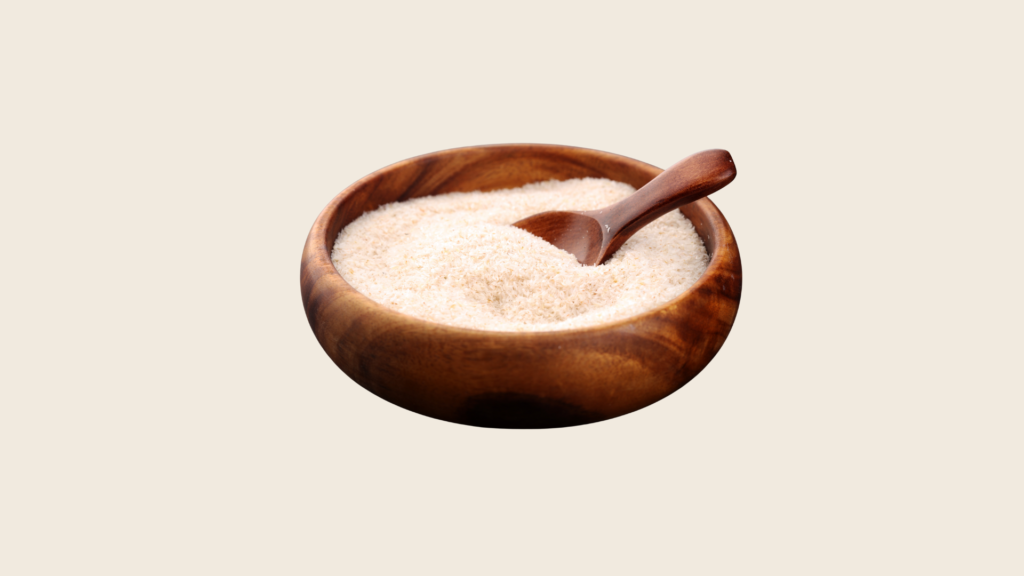
PSYLLIUM HUSK IS often mentioned in discussions around spermatorrhea, but its role is frequently misunderstood. What matters most is not its popularity, its reputation, or even its name — what matters is how it enters the body and how the system responds to it. Spermatorrhea management is not about adding random remedies. It is about understanding how the body behaves under pressure and how stability is gradually restored.
How Psyllium Husk Is Consumed for Spermatorrhea Management?
Psyllium husk behaves very differently depending on its form. In its dry state, psyllium husk is:
- Rough
- Highly absorbent
When it comes into contact with liquid, it:
- Absorbs the liquid
- Expands
- Becomes soft and gel-like
This transformation is not a minor detail. It completely changes how the body responds to it. Because of this nature, psyllium husk is typically consumed in two basic ways.
Soaking Psyllium Husk in Water
The husk is mixed into plain water, stirred well, and left for a few minutes. During this time, it absorbs the liquid and softens. Only after this softening does it become compatible with the system. Dry psyllium should never enter the body.
Soaking Psyllium Husk in Milk
The same principle applies when psyllium husk is soaked in milk. It must be allowed to sit until it becomes fully soft and blended — not grainy or floating. Milk adds nourishment, which is why its quality and temperature matter.
- Only fresh, natural milk such as cow, goat, or buffalo milk is preferred
- Powdered or heavily processed packaged milk is best avoided
If lukewarm milk is used, it should be allowed to cool before consumption. This helps prevent unnecessary internal stimulation while keeping the nourishing effect gentle.
Some people soak one tablespoon of psyllium husk in one glass of milk at night and consume it in the morning on an empty stomach.
By then, the mixture becomes:
- Soft
- Thick
- Mildly sweet
- Milky in texture
Whether psyllium husk is taken with water or milk depends on personal comfort and tolerance. Both methods are commonly used. From a system perspective, timing is secondary. What matters most is one rule:
Psyllium husk must never be taken dry.
Dietary Habits That Support Psyllium Husk Benefits
Psyllium husk does not work in isolation. It works inside a dietary environment. In the Natural Herbal System, psyllium husk is classified as:
Cold & Wet temperament — Level 2
Its natural direction is:
- Cooling
- Softening
- Soothing
- Calming internal irritation
However, a system stabilizes only when temperaments align. If psyllium is introduced as a Cold & Wet element while daily eating habits continue to push the body toward a Hot & Dry temperament, its calming effect becomes weak and inconsistent. Hot & Dry dietary habits tend to create:
- Internal heat
- Tissue dryness
- Digestive irritation
- Increased nervous sensitivity
When heat and dryness dominate, the body remains in a slightly tense and reactive state. In such a condition, even supportive elements cannot express their full effect. This is why some men feel psyllium is “doing nothing.”
Often, psyllium is not the issue — the internal environment is still being heated and dried daily.
The goal is not strict food control. The goal is not cancelling out psyllium’s soothing nature.
When dietary habits reduce excessive heat and dryness, psyllium is able to support calmer digestion and reduce background pressure more effectively. Alignment matters more than intensity.
Lifestyle Changes That Increase Psyllium Husk Benefits
Psyllium husk mainly supports digestion and internal pressure. But spermatorrhea is not shaped by digestion alone. It is also influenced by:
- Nervous system sensitivity
- Daily rhythm
- Sexual stimulation patterns
This is where lifestyle becomes critical.
Daily Walking
Walking reduces stagnation in the body. It helps digestion move smoothly and prevents pressure buildup in the lower abdomen. A body that walks daily does not hold internal tension easily.
Light to Moderate Exercise
This is not about pushing the body hard. It is about circulation. Movement prevents congestion in the pelvic region, and congestion often increases sensitivity.
Sleep Quality
Sleep is where the nervous system resets. When sleep quality is poor:
- Sensitivity increases
- Reactions become quicker
- Control weakens
Even if digestion improves, a disturbed nervous system keeps the sexual organs reactive.
Avoiding Excessive Sexual Stimulation
Pornography, masturbation, and repeated sexual stimulation train the nervous system to remain alert and responsive. This is not a moral issue. It is conditioning.
When digestion is supported and lifestyle reduces nervous over-activation, the system gradually returns toward balance — quietly and without force.
Why Psyllium Husk Effects Feel Slow?
After understanding consumption, diet, and lifestyle alignment, many men ask an internal question:
Why does improvement feel slow?
This comes from misunderstanding how the system changes. Spermatorrhea does not develop suddenly. It forms gradually, layer by layer.
- Sensitivity increases slowly
- Semen retention power weakens slowly
Stabilization follows the same pattern. Each element works at a different layer:
- Psyllium supports digestion and internal pressure
- Diet influences tissue temperament
- Lifestyle affects nervous system sensitivity
These layers are connected, but they do not reset together — and they do not reset instantly. Early changes are subtle:
- Less strain during waste elimination
- Smoother bowel movements
- Reduced disturbance after meals
- A quieter digestive rhythm
These are background changes, not dramatic events. Because spermatorrhea involves long-term conditioning, the system does not respond well to force. It responds to re-learning. Slow progress:
- Does not mean failure
- It means the system is reorganizing instead of being pushed
Force creates rebound. Re-learning creates stability.
Common Mistakes That Reduce Psyllium Husk Effectiveness
Even when the method is correct, small mismatches can quietly reduce effectiveness.
Rushing the Process
Frequent changes in timing, quantity, or method prevent the system from settling. Stability comes from repetition, not constant experimentation.
Mixing Too Many Things Together
Taking psyllium alongside heavy foods or multiple substances overloads digestion. Competition begins, softening becomes secondary, and pressure returns quietly.
Ignoring Sexual Stimulation Patterns
Even with improved digestion, a highly stimulated nervous system keeps sensitivity elevated. Sensitivity does not come from digestion alone.
Inconsistency
Irregular timing creates irregular signals. Biological systems respond best to rhythm. These are not failures. They are alignment issues. When the system is kept simple, calm & consistent, psyllium husk performs its role quietly — as a stabilizing element, not a quick fix. And stability is what allows deeper change over time.
Closing Message
Psyllium husk is not meant to create sudden change. Its role is to support the body while stability is rebuilt at deeper levels. When digestion is softened, diet is aligned, and lifestyle reduces pressure, the system slowly learns calm again. Progress may feel quiet, but quiet change is often the most durable. In spermatorrhea management, stability is not forced — it is re-established through consistency, alignment & time.
